How we work
Custom weather routing, with you in the lead
We offer you two responsibility models to choose from:
- Ocean-Pro Weather & Routing primarily responsible — Ocean-Pro Weather & Routing leads on weather analysis and routing recommendations, with the owner or captain approving.
- Owner/Captain primarily responsible — the yacht owner or captain leads on weather analysis and routing decisions, with Ocean-Pro Weather & Routing reviewing and approving.
Either way, every forecast and routing decision will have your and Ocean-Pro Weather & Routing's input, and the yacht's performance parameters, the weather, and your and your crew's best interests foremost in mind.
Our recommended process
- Registration & pre-departure consultation — client completes the Ocean-Pro Client, Vessel & Passage Registration form (owner info, billing contact and address, vessel and passage parameters, communication and departure plans, and choice of ongoing report format and primary model — see below), and we review it together for adequacy by email, phone, or video, typically a week or more before you plan to leave the dock.
- Initial forecast & route — we send you an initial forecast for your departure, a recommended departure time, and a route built around both the weather and your vessel's parameters and proposed crew. This includes:
- our Departure Weather Window Report — a one-page screening of the days ahead, drawing on both GFS and ECMWF together, for the best (or least undesirable) day and time to leave the dock;
- your first Weather Synopsis & Routing Report, in the report format you've chosen (see below); and
- a voice discussion of both reports and your intentions.
Upon your registering, we will discuss and choose which ongoing report format and weather model priority best suits your passage:
- Dual-Model Synopsis, Weather & Routing Report — draws on GFS and ECMWF together, side by side. One document, two pages: page one carries a full weather synopsis for each model; page two carries a routing table and a weather/seas table for each, plus a comparative summary of where the two models agree or diverge.
- Single-Model Synopsis, Weather & Routing Report — a shorter, one-page format, drawing on either the GFS or ECMWF weather model. Together we'll agree which model is primary and which is secondary; the report is built from the primary model chosen, with the secondary model reconciled against it in a short comparison narrative.
We provide 3-6 day forecasts & routing advice in 24-hour intervals, covering skies, cloud cover, visibility, barometric pressure, temperature, winds, seas, and the probability, timing, and intensity of any rain, squalls, or storms. Each is refined using our AI-enhanced analysis of current and historical model data alongside your sailing vessel's own VPP data, if you have one on file — if not, we may have or be able to build one for your vessel. Reports are sent by email or WhatsApp: the Departure Weather Window Report typically 1–4 days before your tentative departure, and your first Single-Model Synopsis, Weather & Routing Report typically 1-2 days before departure and then daily thereafter — see Pricing & Payment below for Dual-Model frequency and full detail.
- Daily two-way communications — prior to your departure and then each day underway, or more often, you send us your position, status, and intentions, and we send back your Weather Synopsis & Routing Report, in your chosen format, by email or WhatsApp, adjusted for changes in your vessel's position, status, intentions, course & speed, and the weather forecast. Daily two-way communication repeats every day until you have arrived safely in a port or anchorage or have arrived at your final destination.
Storm & current monitoring
In the mid and higher latitudes of both hemispheres, we closely track the formation, development, strength, size, and movement of highs, lows, storms, and fronts to advise on utilizing favorable winds or avoiding heavy weather. In the tropics, we monitor the ITCZ (doldrums), trade winds, and the formation, track, and wind field of any tropical storms so we can recommend utilizing or avoiding them. Where a passage crosses a major ocean current — the Gulf Stream, Agulhas, or an equatorial current — we factor that current into our routing advice on using or avoiding the current.
What's included
- Initial weather, vessel, and crew reality check for departure and for every day underway.
- Route adjustments in real time as conditions develop or diverge from the forecast
- Direct availability during the passage — not a call center or a rotating desk of forecasters
- One point of contact throughout — you're speaking with Capt. Bob Cook from registration to arrival, every time
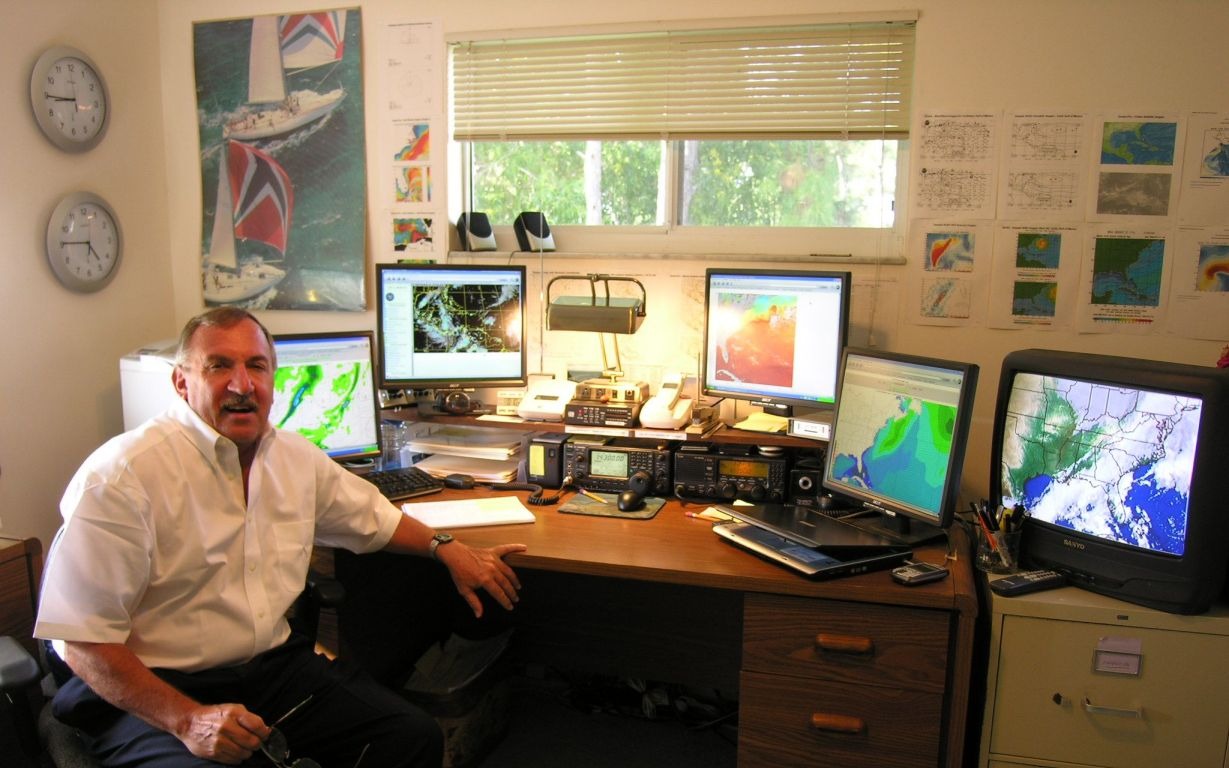
Monitoring weather and routing screens, mid-passage
- Additional help if needed — contact with family, ports-of-call, Customs and Immigration offices, or liaison with the USCG or SAR services
Communications options
- Contact methods: Telephone, video conference (Zoom), text message, email, WhatsApp, or other by arrangement.
- Satellite services (typical): Starlink, KVH, Viasat, Iridium, Inmarsat.
- Position tracking: PredictWind, Marine Traffic, MyShipTracking, ShipFinder, Ship Atlas, Garmin inReach.
A note on text/SMS-only devices: Two-way satellite email or WhatsApp is strongly preferred over voice or SMS text alone. Short-message devices such as Garmin inReach, limited to 160 characters, can be a helpful backup but are not sufficient on their own — please confirm you have reliable, two-way digital communications capability before you depart.
A note on tracking: Vessel tracking platforms are separate from messaging and are very helpful in showing us your latest position, course, and speed, and sometimes basic weather. We recommend incorporating a vessel tracking and reporting system into your passage — note that Garmin inReach used for tracking is a separate function from its SMS messaging noted above.
Pricing and payment
| Report | Model | Price | Default frequency |
|---|
| Departure Weather Window Report | GFS or ECMWF (primary model; secondary reconciled) | $50 / report | 1 report, sent 1–4 days before tentative departure |
| Single-Model Synopsis, Weather & Routing Report | GFS or ECMWF (primary model agreed together before departure) | $50 / report | 1-2 days before departure and then daily thereafter. |
| Dual-Model Synopsis, Weather & Routing Report | GFS and ECMWF | $100 / report | Every 2 days (daily if you choose) |
| Item | Detail |
|---|
| Minimum charge | $300 |
| Longer passages | 33–50% of the estimated charge for the full passage to be paid upon registration; the balance of the estimated charge for the full passage is agreed to be paid mid-passage or no later than at the conclusion of the passage |
Our acceptable payment methods — secure online payment via Stripe's secure online invoice and payment service (credit card, debit card, or ACH bank transfer from U.S. accounts), or Zelle or Venmo's secure online digital payment service.
Some examples of how our pricing formula works:
- Sailing yacht example: a 2,500 nm ocean passage expected to take about 16 days might need roughly 8 forecasts — 1-2 before departure and 6-7 underway. At $100/full forecast, that's about $800 total.
- Motor yacht example, 1,000 nm passage at two speeds: at an off-plane cruising speed of 10 kts, the passage takes about 100 hours (~4 days), typically needing 1 pre-departure forecast plus 2 underway (every-other-day) — about $300. At an on-plane cruising speed of 30 kts, the same 1,000 nm passage takes about 33 hours (~1.4 days), typically needing just 1 pre-departure forecast plus 1 underway — still $300, since our minimum charge applies.
These are illustrative estimates — your actual number of advisories depends on your vessel's speed, route, and how conditions develop underway.